What Does the Celtic Cross Symbolize? Meaning, History, and Spiritual Significance
If you are wondering what does the Celtic cross symbolize, the answer goes far beyond a simple religious emblem. The Celtic cross is a powerful symbol that blends spirituality, history, and ancient wisdom, representing the connection between the physical world and the spiritual realm. Found in stone carvings, jewelry, sacred sites, and modern art, the Celtic cross carries layers of meaning shaped by both pre-Christian Celtic traditions and later Christian symbolism.
The enduring presence of the Celtic cross across centuries reflects its deep spiritual resonance. It is a symbol of balance, eternity, protection, and divine connection, making it one of the most meaningful symbols to emerge from Celtic culture.
The Origins of the Celtic Cross
To understand what the Celtic cross symbolizes, it is important to look at its origins. The Celtic cross is believed to have emerged in early medieval Ireland and Britain, though its roots reach even further back into ancient Celtic spirituality. Long before Christianity arrived, the Celts revered the sun, nature, and the cycles of life, all of which are reflected in the design of the cross.
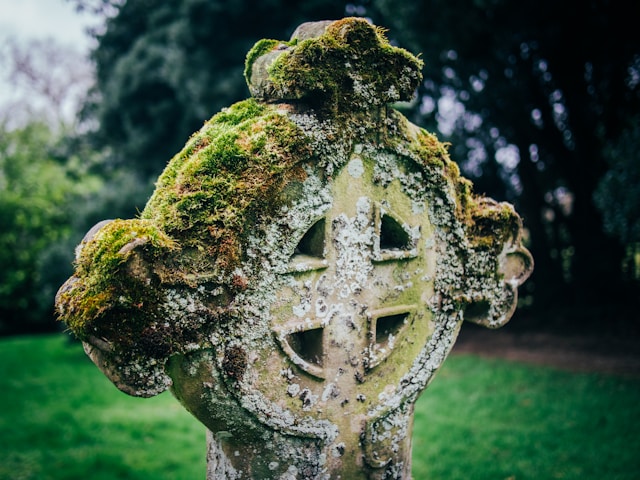
The defining feature of the Celtic cross is the circle that connects the arms of the cross. This circle is widely believed to represent the sun, eternity, or the cyclical nature of existence. When Christianity spread through Celtic lands, the symbol was adapted to include the Christian cross, creating a fusion of pagan and Christian beliefs rather than replacing older traditions entirely.
What Does the Celtic Cross Symbolize Spiritually?
Spiritually, the Celtic cross symbolizes the union of opposites. The vertical line represents the spiritual realm and higher consciousness, while the horizontal line represents the earthly world and human experience. Where these lines intersect, balance is created, symbolizing harmony between heaven and earth.
The circle surrounding the intersection adds another layer of meaning. It represents eternity, wholeness, and the infinite nature of the soul. From a spiritual perspective, the Celtic cross teaches that life is not linear but cyclical, and that spiritual growth continues beyond physical existence.
The Celtic Cross and the Four Directions
Another interpretation of what the Celtic cross symbolizes relates to the four directions and elements. Each arm of the cross can represent north, south, east, and west, as well as earth, air, fire, and water. This interpretation connects the symbol to balance in nature and alignment with universal forces.
In this sense, the Celtic cross acts as a spiritual compass, reminding individuals to stay grounded while remaining open to higher guidance. It reflects the Celtic belief that humans are deeply connected to the natural world and must live in harmony with it.
Christian Meaning of the Celtic Cross
Within Christianity, the Celtic cross symbolizes faith, salvation, and the eternal life promised through Christ. The circle is often interpreted as God’s eternal love or the unending nature of divine presence. Unlike the traditional Christian cross, the Celtic cross emphasizes resurrection and continuity rather than suffering alone.
This interpretation made the Celtic cross especially meaningful in early Christian communities, as it visually communicated both spiritual devotion and hope beyond death. Many ancient Celtic crosses were carved as high crosses, standing tall in sacred spaces as symbols of protection and spiritual authority.
Pre-Christian and Pagan Symbolism of the Celtic Cross
Before Christian influence, the Celtic cross likely symbolized the sun and cosmic order. The circle was a sacred shape in Celtic belief, associated with solar energy, fertility, and life force. The cross itself may have represented the four seasons or the sacred structure of the universe.
From this perspective, what the Celtic cross symbolizes is not limited to religion but includes a broader spiritual worldview that honors cycles, balance, and interconnectedness. This explains why the symbol continues to resonate with modern spiritual seekers beyond Christian contexts.
The Celtic Cross as a Symbol of Protection
Protection is another key aspect of what the Celtic cross symbolizes. Historically, Celtic crosses were placed in important locations such as monasteries, crossroads, and burial sites. They were believed to guard sacred spaces and offer spiritual protection to those nearby.
Today, many people wear Celtic cross jewelry or display the symbol in their homes as a protective talisman. It is often associated with strength, guidance, and resilience during times of challenge or transition.
The Celtic Cross and Eternity
One of the most enduring meanings of the Celtic cross is eternity. The circle surrounding the cross has no beginning or end, symbolizing the eternal nature of the soul and the continuity of spiritual existence. This meaning aligns with both Celtic beliefs in reincarnation and Christian beliefs in eternal life.
Understanding what the Celtic cross symbolizes in this context reveals why it is commonly found in memorials and gravestones. It serves as a reminder that death is not an ending, but a transformation within a larger spiritual journey.
Modern Interpretations of the Celtic Cross
In modern times, the Celtic cross has taken on personal and spiritual meanings that extend beyond traditional interpretations. Many people see it as a symbol of heritage, identity, and ancestral connection. Others are drawn to its message of balance, unity, and spiritual grounding.
The Celtic cross is also embraced by those on spiritual paths that honor both ancient wisdom and personal growth. Its timeless design allows it to remain relevant while adapting to contemporary spiritual understanding.
What Does the Celtic Cross Symbolize in Daily Life?
On a practical level, what the Celtic cross symbolizes can vary from person to person. For some, it represents faith and devotion. For others, it symbolizes balance, protection, and alignment with higher purpose. The symbol often appears during periods of reflection, change, or spiritual exploration.
Because of its layered meanings, the Celtic cross invites contemplation rather than rigid interpretation. It encourages individuals to reflect on their own connection to spirituality, nature, and the cycles of life.
Final Thoughts on What the Celtic Cross Symbolizes
The Celtic cross is a symbol rich in history, spirituality, and timeless wisdom. It represents the meeting point of earth and spirit, the eternal cycle of life, and the balance that sustains both the human and divine experience. Understanding what does the Celtic cross symbolize reveals why it continues to hold deep meaning across cultures, religions, and generations.
Whether viewed through a spiritual, cultural, or personal lens, the Celtic cross remains a powerful reminder of unity, protection, and the enduring connection between the visible and invisible worlds.