Yin Yang Symbol Meaning: What Balance Truly Means in Spiritual Life
The Yin Yang symbol is one of the most recognized spiritual symbols in the world. At first glance, it seems simple: two opposite shapes flowing into one another, one dark, one light. Yet behind this image lies a philosophy that has shaped Eastern thought, medicine, spirituality, and daily life for thousands of years.
Understanding the Yin Yang symbol meaning goes far beyond the idea of “good versus bad” or “light versus dark.” In reality, Yin Yang represents balance, movement, and interdependence, a way of understanding life as a dynamic process rather than a fixed state.
This article explores the symbolic, spiritual, and psychological meaning of Yin Yang in a grounded and realistic way, without mystification, while honoring its depth.
What Is Yin and Yang?
Yin Yang is a central concept in Taoist philosophy, originating in ancient China. Rather than being a religion, Taoism is a way of observing how life naturally unfolds.
The term “Yin Yang” describes two complementary forces that exist in everything. These forces are not enemies. They depend on one another, define one another, and constantly transform into each other.
Yin is often associated with darkness, stillness, intuition, receptivity, and inward movement.
Yang is associated with light, activity, logic, expansion, and outward movement. Importantly, neither Yin nor Yang exists alone. One cannot exist without the other.
The Yin Yang Symbol Meaning
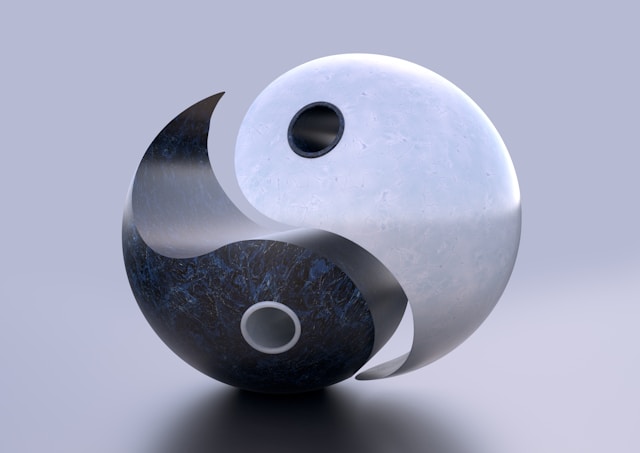
The traditional Yin Yang symbol, also called the Taijitu, visually expresses this philosophy.
The circle represents wholeness and unity. Inside, the dark and light shapes flow into each other in a continuous curve, showing that life is always in motion. Each side contains a small dot of the opposite color. This detail is essential. It symbolizes that:
- Yin always contains the seed of Yang
- Yang always contains the seed of Yin
This reminds us that no state is permanent. Strength can turn into weakness. Stillness can become movement. Joy can hold sorrow, and difficulty can carry growth.
Yin Yang Is Not About Good and Evil
One of the most common misunderstandings is interpreting Yin Yang as a moral battle between good and bad. This interpretation is inaccurate.
Yin and Yang are neutral forces. Neither is superior. Problems arise not from Yin or Yang themselves, but from imbalance.
For example:
- Too much Yang can lead to burnout, aggression, and control.
- Too much Yin can lead to stagnation, passivity, and withdrawal.
The goal is not to eliminate one side, but to maintain a dynamic balance that adjusts as life changes.
Spiritual Meaning of Yin Yang
Spiritually, Yin Yang represents the idea that wholeness includes contrast.
Many spiritual paths search for light, peace, and transcendence. Yin Yang reminds us that darkness, rest, and introspection are not spiritual failures – they are necessary parts of growth. From a spiritual perspective, Yin Yang teaches:
- acceptance of life’s cycles
- respect for natural rhythms
- harmony instead of resistance
Rather than escaping reality, Yin Yang spirituality encourages living in alignment with reality as it is.
What Color is Yin and What Color is Yang?
The colors of the Yin Yang symbol – black and white – are not random or purely aesthetic. They carry deep symbolic meaning.
Black represents Yin. It symbolizes darkness, the unknown, depth, rest, mystery, and the unconscious. Black is not negative; it is the space where potential forms. It represents night, stillness, and the fertile ground where transformation begins.
White represents Yang. It symbolizes light, clarity, awareness, movement, and conscious action. White reflects visibility, direction, and expansion. It represents day, activity, and outward expression.
Together, black and white illustrate that:
- clarity emerges from the unknown
- action follows rest
- awareness is born from introspection
Psychological Meaning of Yin Yang
Psychologically, Yin Yang can be understood as the balance between different aspects of the human mind.
Yang aligns with logic, action, planning, and external achievement.
Yin aligns with emotion, intuition, rest, and internal processing.
Modern life often overvalues Yang energy: productivity, speed, constant action. As a result, many people experience anxiety, exhaustion, and disconnection from themselves.
Yin Yang symbolism reminds us that mental health depends on:
- knowing when to act
- knowing when to pause
- valuing rest as much as effort
Balance is not static. It requires continuous self-awareness.
Yin Yang and Masculine & Feminine Energy
One of the most misunderstood aspects of Yin Yang is its connection to masculine and feminine energy.
In Yin Yang philosophy, masculine and feminine are energetic principles, not biological gender. Every person carries both Yin and Yang energies, regardless of sex or identity.
Yang energy is traditionally associated with the masculine principle. It represents action, assertion, direction, logic, and outward movement. Yang is active and expressive, often linked to leadership, decision-making, and physical energy.
Yin energy is associated with the feminine principle. It represents receptivity, intuition, emotion, stillness, and inward movement. Yin is reflective, nurturing, and connected to rest, creativity, and emotional depth.
The key teaching here is not opposition, but interdependence. Masculine energy without feminine awareness becomes forceful and unbalanced. Feminine energy without masculine structure can become passive or stagnant. Yin Yang reminds us that wholeness comes from integration, not dominance of one energy over the other.
Masculine and Feminine Balance in Daily Life
In modern society, Yang (masculine) energy is often overvalued. Productivity, speed, achievement, and constant action are praised, while rest, emotional processing, and intuition are seen as weaknesses.
This imbalance leads to:
- burnout
- emotional disconnection
- chronic stress
- loss of meaning
Yin Yang symbol meaning invites a redefinition of strength. True balance means knowing when to act and when to receive, when to lead and when to listen. Masculine and feminine energies are not roles to perform, but states to move between depending on life’s demands.
+ Read More: Celtic Symbol for Strength: What the Ancients Knew About True Power
Yin Yang in Daily Life
Yin Yang is not an abstract concept. It appears constantly in everyday experiences.
Day and night
Work and rest
Speaking and listening
Giving and receiving
When one side dominates for too long, imbalance appears. Fatigue, frustration, or emotional numbness are often signs that one energy has been neglected. Living with Yin Yang awareness means asking:
- Where am I pushing too hard?
- Where am I avoiding movement?
- What is missing right now?
Yin Yang and Relationships
In relationships, Yin Yang represents complementary dynamics, not fixed roles.
Healthy relationships require moments of:
- closeness and space
- communication and silence
- support and independence
Problems arise when one dynamic becomes rigid. When one person always gives and the other always receives, imbalance grows. Yin Yang teaches that relationships thrive through mutual adjustment, not control.
Yin Yang in Dreams and Spiritual Signs
In dreams and symbolic experiences, Yin Yang imagery often appears during periods of transition.
Dreaming of contrasting elements, light and shadow, fire and water, movement and stillness can reflect an inner search for balance. Seeing the Yin Yang symbol repeatedly may indicate:
- internal conflict between action and rest
- difficulty accepting opposing emotions
- a need to integrate different parts of the self
Rather than predicting events, such signs invite reflection and self-regulation.
Balance Does Not Mean Perfection
One of the most important lessons of Yin Yang is that balance is not permanent. Life constantly shifts. What feels balanced today may feel excessive tomorrow. Yin Yang balance is responsive, not rigid.
This understanding removes the pressure to “get it right forever” and replaces it with flexibility and compassion.
Common Misinterpretations of Yin Yang
Many modern interpretations oversimplify Yin Yang into slogans or aesthetic symbols without depth. Common mistakes include:
- associating Yin with weakness and Yang with strength
- treating balance as a fixed state
- ignoring cultural and philosophical roots
True Yin Yang understanding is subtle. It requires observation, not labels.
Yin Yang as a Life Philosophy
At its core, Yin Yang offers a way of living that values awareness over control.
It teaches that:
- resistance creates suffering
- imbalance signals adjustment, not failure
- opposites are not problems, but partners
This philosophy is especially relevant in a world that pushes extremes — constant productivity or complete withdrawal, absolute certainty or total confusion. Yin Yang offers a middle path that is flexible, grounded, and deeply human.
What Yin Yang Symbol Meaning Really Teaches Us
The Yin Yang symbol does not promise happiness, success, or enlightenment. What it offers is something more sustainable: understanding.
Understanding that life moves in cycles.
Understanding that contrast is necessary.
Understanding that balance is lived, not achieved once.
Yin Yang reminds us that wholeness is not about choosing one side, but about honoring both.