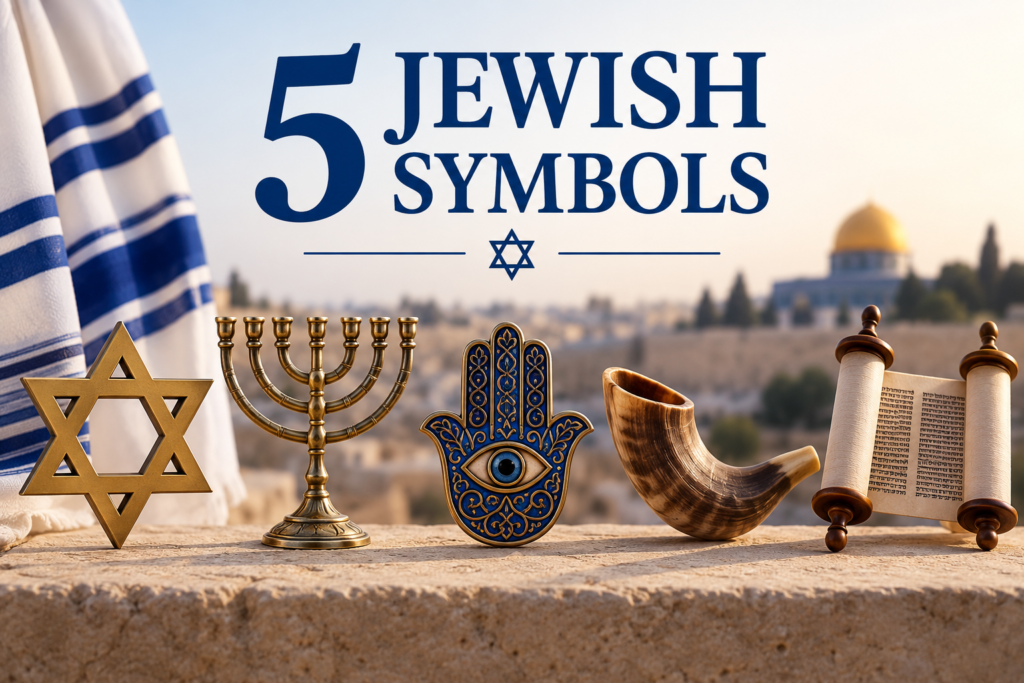
5 Jewish Symbols and What They Mean (A simple, meaningful guide)
The moment you start learning about Jewish symbols and what they mean, something quietly shifts. Even the most familiar shapes carry specific, memorable details — like the menorah being “seven-branched.” That kind of precision is what makes symbolism feel real instead of abstract.
Key Takeaways
| Symbol | Core meaning (in everyday words) |
| Star of David | Identity, protection, and connection through a clear geometric form |
| Menorah | Light, continuity, and spiritual teaching |
| Chai | Life itself, carried through Hebrew letters |
| Hamsa | Protection and good fortune, often interpreted by hand orientation |
| Pomegranate | Fullness, commandments, and sacred countings |
Why People Search for Jewish Symbols and What They Mean
We believe meaning is everywhere, if you know how to look. Symbols are one of the most accessible ways the universe communicates – using images, traditions, and repeating patterns rather than direct language.
When people search for Jewish symbols and what they mean, they’re usually trying to do one of three things: understand what a symbol represents in a Jewish context, understand why the symbol looks the way it does, or connect it to their own life — their own questions, their own quiet longing for clarity.
This guide keeps it simple. For each symbol, we cover what it commonly represents, where the meaning often shows up, and a small way you can “decode” it with intention. Read, reflect, question, and most importantly, follow your curiosity.
The Star of David: Two Triangles, One Identity
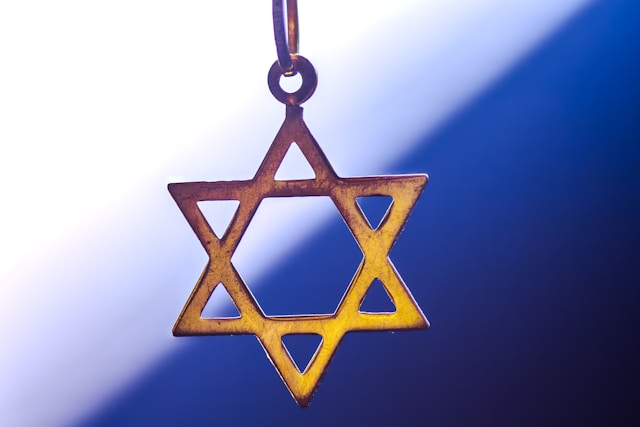
In Hebrew, the Star of David is called Magen David — “Shield of David” — and it’s formed by two overlapping equilateral triangles, creating a six-pointed hexagram with a small hexagon at its center.
Despite being the most instantly recognizable Jewish symbol today, the star itself isn’t originally Jewish in origin: hexagrams like it appear in Bronze and Iron Age artifacts across Mesopotamia, India, and Britain, long before it took on any Jewish meaning. It only began appearing consistently on Jewish artifacts and manuscripts in the Middle Ages, and it was the Jewish community of Prague in the 17th century that formally adopted it as a communal emblem.
+ Related: Understanding the Symbolism and Superstitions of Friday the 13th
The name “Shield of David” is a matter of legend, not history — there’s no archaeological evidence that King David actually used a six-pointed star as a battle emblem. The symbolism that stuck came later, largely through Kabbalah: one widely cited reading holds that the six points represent God’s rule in all six directions — north, south, east, west, up, and down — while the central hexagon stands for the balance point between them.
The star’s status as the symbol of Jewish identity is relatively recent. It was adopted by the Zionist movement in 1897 and placed on their flag, later becoming the central image on the flag of the State of Israel in 1948. It’s also the emblem of Magen David Adom, Israel’s national emergency medical and ambulance service — literally, the “Red Shield of David,” Israel’s equivalent to the Red Cross.
Menorah: The Seven-Branched Light
The menorah people are most often referring to when they say “the” menorah is the seven-branched gold candelabrum described in the book of Exodus (25:31–40), originally built for the Tabernacle and later kept burning in the Temple in Jerusalem. Its design was specific and deliberate: one central shaft with three curved branches extending from each side, all holding oil lamps at the same height.
Did You Know? The menorah is “seven-branched.” (Source: Union for Reform Judaism)
The number seven wasn’t incidental. In Jewish tradition, the six outer branches are often read as representing the six days of Creation, with the central branch standing for Shabbat — making the menorah a physical echo of the creation story itself. The Talmud also describes it as a symbol of human wisdom and enlightenment, with the central light “feeding” illumination outward to the rest.
It’s worth knowing there are actually two different menorahs in Jewish life, and mixing them up is a common mistake. The seven-branched Temple menorah is the ancient, biblical version — it’s also the emblem on Israel’s official state seal.
The nine-branched hanukkiah, used during Hanukkah, is a related but distinct object: eight branches for the eight nights of the holiday, plus a ninth raised or offset branch called the shamash (“helper”), used to light the others. The hanukkiah commemorates the Hanukkah miracle of the oil, while the seven-branched menorah predates that story by centuries.
+ Read More: Yin Yang Symbol Meaning: What Balance Truly Means in Spiritual Life
Chai: The Symbol of Life, Carried in Hebrew
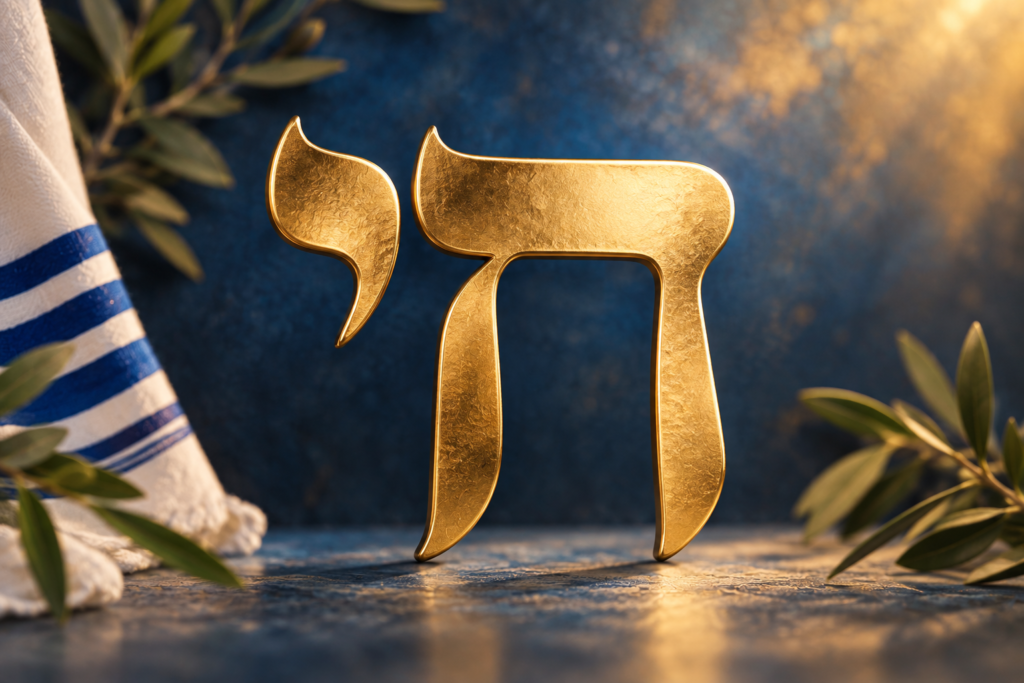
Chai (חַי) is Hebrew for “living” or “life,” spelled with just two letters: chet (ח) and yud (י). Those two characters are almost always rendered together as a single compact glyph, which is why Chai reads instantly even to people who don’t know Hebrew — it’s less a sentence and more a small piece of visual sculpture.
The deeper layer comes from gematria, the Jewish tradition of assigning numerical values to Hebrew letters: chet equals 8, yud equals 10, and together they add up to 18. That’s the real reason 18 is considered a lucky number in Jewish culture, and why charitable donations, wedding gifts, and bar/bat mitzvah checks are so often given in multiples of 18 — $18, $180, $1,800. Giving “chai” is, quite literally, a way of wishing someone life.
The symbol’s use as jewelry traces back to medieval Spain, with its more common role as a protective amulet emerging in 18th-century Eastern Europe. Today it remains one of the most-worn Jewish symbols, often paired with a Hamsa or Star of David on the same chain, and it shows up at nearly every Jewish milestone — a quiet, wearable version of the toast “L’chaim” — “to life.”
Hamsa: Protection, Often Interpreted Through Orientation
The word Hamsa comes from the Arabic khamsa and the Hebrew hamesh, both meaning “five” — a direct reference to the five fingers of the open, palm-forward hand it depicts. It’s one of the oldest protective symbols in the Middle East and North Africa, with imagery found on Israelite tombs dating back to the 8th century BCE, predating both Judaism and Islam’s use of it as we know it today.
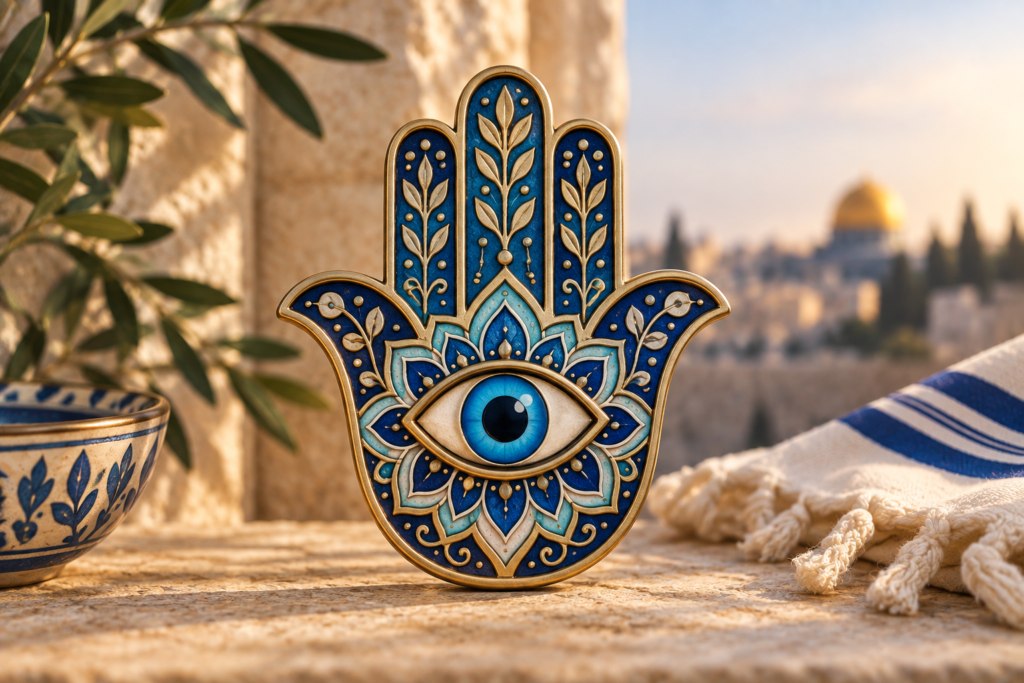
In Jewish tradition, the Hamsa is often called the Hand of Miriam, after Moses and Aaron’s sister, who is remembered in the Torah as a protective, resilient figure during the Exodus. Its central purpose has always been guarding against the ayin hara — the “evil eye,” the belief that envy or ill will can cause harm — while also inviting blessing, health, and good fortune.
Jewish interpretations frequently connect the five fingers to the five books of the Torah, and a Hebrew letter Shin (ש) is sometimes added to the palm, standing for Shaddai (“Almighty”) — the same letter found on a mezuzah.
Read this slowly, and let it land the way symbols often do when they’re meant to be remembered:
Common interpretation: the Hamsa is believed to ward off evil “if the fingers are facing up,” and bring good fortune “if the fingers are pointed downwards.”
As for orientation: fingers pointing up are generally read as warding off the evil eye, while fingers pointing down are read as inviting in blessing and good fortune — though it’s worth knowing there’s no single, universally binding rule here. Hamsas are worn and displayed both ways across Jewish communities, and the “correct” direction often comes down to regional custom more than fixed law.
+ Related: Symbolism of the Crescent Moon: What Ancient Civilizations Knew?
Pomegranate: Fullness, 613 Commandments, and Sacred Countings
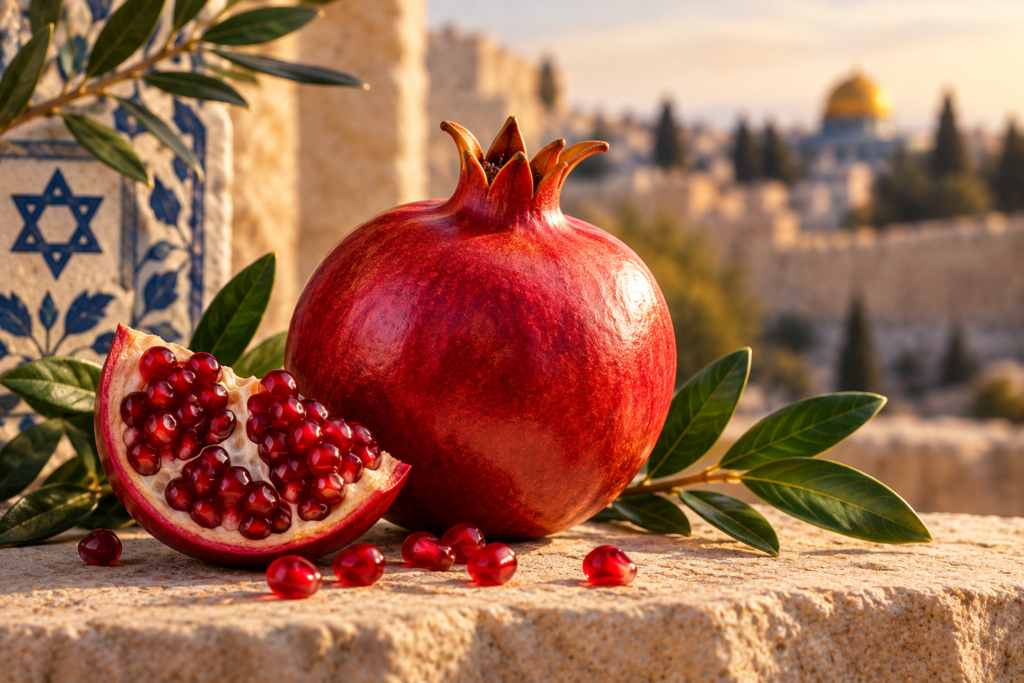
The pomegranate is one of the Seven Species (Shivat HaMinim) named in the Torah as native to the Land of Israel, alongside wheat, barley, grapes, figs, olives, and dates.
Its most famous association, though, comes from a popular belief that a pomegranate contains exactly 613 seeds — matching the traditional count of the 613 mitzvot (commandments) in the Torah. Before eating pomegranate seeds at the Rosh Hashanah table, it’s customary in Sephardic tradition to say: “May we be as full of mitzvot as the pomegranate is full of seeds.”
Did You Know? The pomegranate is associated with “the 613 commandments in the Torah.” (Source: Union for Reform Judaism)
It’s worth being upfront that the 613-seed claim is more folklore than botanical fact — actual seed counts vary widely. But the symbolism has outlasted the literal count: the pomegranate is generally understood to represent abundance, righteousness, and fruitfulness. Pomegranate-shaped ornaments called rimonim still top many Ashkenazi Torah scroll covers today, and the fruit appears throughout the Song of Songs as an image of beauty and love.
The pomegranate also ties into the Jewish calendar itself: in Israel, pomegranates ripen right around Rosh Hashanah, giving the holiday’s “new fruit” blessing a literal, seasonal anchor — a reminder that Jewish symbolism is often rooted in agricultural reality, not just abstract meaning.
How to Decode These Symbols in Your Own Life (Without Overcomplicating It)
We’re not here to turn symbols into puzzles that require perfect knowledge. Our approach is simpler, grounded, and aware. By learning to read the symbolic language of the universe, we become more connected, grounded, and aware.
Here’s a practical way to work with Jewish symbols and what they mean on a personal level, even if you’re just starting:
- Notice what you see. If a symbol keeps appearing, that’s information. The mirror hour 17:17 is far more than a simple coincidence on the clock, and symbol repetition can feel similar — not identical, just similarly meaningful.
- Choose one question. For example: “What does this symbol ask me to remember?” or “Where do I need light, life, protection, or fullness?”
- Make it a daily micro-practice. Spend 20 seconds with the symbol in your mind. Name the meaning. Then choose one small action that matches it.
- Track the pattern. If your emotions shift after noticing the symbol, you’re already doing the work. We tend to overlook how quickly symbolism can change our inner weather.
This is also why we love guiding readers through categories. If you want more of the “how to notice meaning” side, explore our Universe content. If you want the dreamy angle, our Dreams category can add a deeper layer to how symbols show up in your inner world.
Thank you for being here. May you always find meaning in the mystery.
Conclusion
So, when you learn about Jewish symbols and what they mean, you’re not just collecting facts. You’re learning a symbolic language that can feel like a quiet conversation from the universe — using familiar shapes to point toward identity, light, life, protection, and sacred fullness.
And if you want to go even deeper, keep one thread going. Our Tree of Life symbol article is a powerful companion when you’re ready for more structure, more sacred geometry, and more layers of meaning.
Frequently Asked Questions – FAQ
What are the 5 Jewish symbols and what do they mean? The five most widely recognized Jewish symbols are the Star of David (identity and protection), the menorah (light and continuity), Chai (life), the Hamsa (protection against the evil eye), and the pomegranate (abundance and the 613 commandments). Each one carries centuries of layered meaning — some biblical, some mystical, some folk tradition and together they cover the core themes of Jewish symbolism: faith, protection, identity, and blessing.
What does the Star of David symbolize in Jewish tradition? Known in Hebrew as Magen David (“Shield of David”), it’s a hexagram formed by two overlapping triangles. Its most common interpretation, rooted in Kabbalah, holds that the six points represent God’s rule over all six directions of space — north, south, east, west, up, and down. Despite feeling ancient, its use as the central symbol of Jewish identity is fairly recent: it wasn’t formally adopted until the 17th century in Prague, and it only became the emblem of the State of Israel in 1948.
Why is the menorah considered such an important Jewish symbol? The seven-branched menorah, described in detail in the book of Exodus, originally burned in the Tabernacle and later in the Temple in Jerusalem. Its six outer branches are traditionally linked to the six days of Creation, with the central branch representing Shabbat — making the object a physical retelling of the Genesis story. It’s important to distinguish it from the nine-branched Hanukkah menorah (hanukkiah), which is a separate, later object tied specifically to the Hanukkah oil miracle.
What does Chai mean, and why do people wear it? Chai (חַי) is the Hebrew word for “life,” written with two letters — chet and yud — whose numerical values add up to 18 under Jewish gematria. That’s why 18 is considered a lucky number in Jewish culture, and why gifts and donations are so often given in multiples of it. Wearing Chai jewelry is, in effect, a quiet daily version of the toast “L’chaim” — “to life.”
How does the Hamsa symbol protect people, and does orientation matter? In Jewish tradition, the Hamsa — often called the Hand of Miriam — is worn or displayed to guard against the ayin hara (evil eye) and to invite blessing and good health. Many people read fingers-up as protective and fingers-down as inviting blessing, but there’s no single fixed rule across Jewish communities; both orientations are common, and the “correct” one tends to come down to local or family custom rather than religious law.
What does the pomegranate symbolize in Judaism? The pomegranate is popularly said to contain 613 seeds, matching the traditional count of the 613 mitzvot (commandments) in the Torah — though real seed counts vary, so the number is symbolic folklore rather than a literal fact. It’s also one of the Seven Species native to the Land of Israel, and it’s customarily eaten on Rosh Hashanah with a blessing wishing for a year “as full of merits as the pomegranate is full of seeds.”
Keep Discovering: